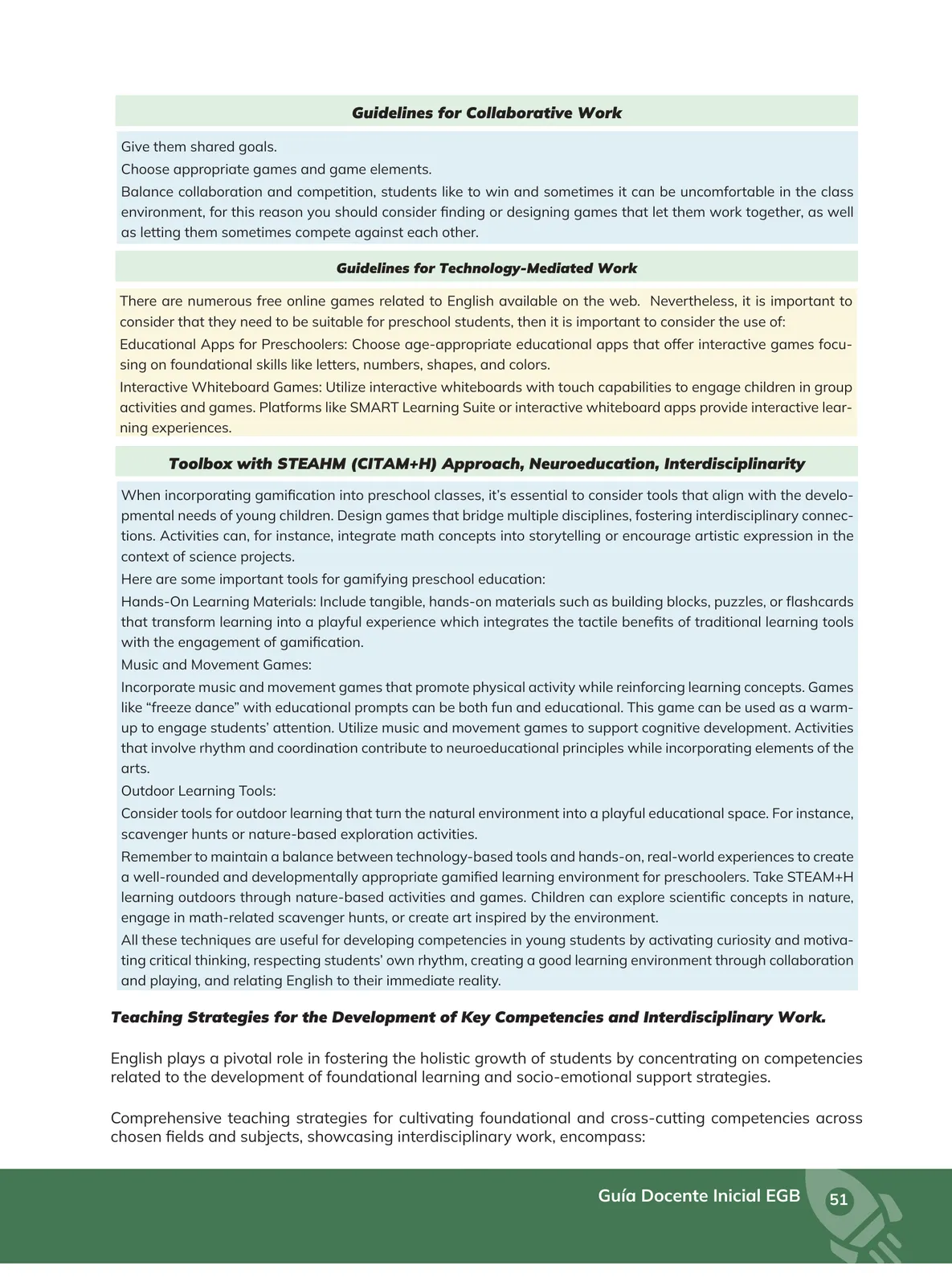
Guidelines for Collaborative Work
Give them shared goals.
Choose appropriate games and game elements.
Balance collaboration and competition, students like to win and sometimes it can be uncomfortable in the class
environment, for this reason you should consider finding or designing games that let them work together, as well
as letting them sometimes compete against each other.
Guidelines for Technology-Mediated Work
There are numerous free online games related to English available on the web. Nevertheless, it is important to
consider that they need to be suitable for preschool students, then it is important to consider the use of:
Educational Apps for Preschoolers: Choose age-appropriate educational apps that offer interactive games focu-
sing on foundational skills like letters, numbers, shapes, and colors.
Interactive Whiteboard Games: Utilize interactive whiteboards with touch capabilities to engage children in group
activities and games. Platforms like SMART Learning Suite or interactive whiteboard apps provide interactive lear-
ning experiences.
Toolbox with STEAHM (CITAM+H) Approach, Neuroeducation, Interdisciplinarity
When incorporating gamification into preschool classes, it's essential to consider tools that align with the develo-
pmental needs of young children. Design games that bridge multiple disciplines, fostering interdisciplinary connec-
tions. Activities can, for instance, integrate math concepts into storytelling or encourage artistic expression in the
context of science projects.
Here are some important tools for gamifying preschool education:
Hands-On Learning Materials: Include tangible, hands-on materials such as building blocks, puzzles, or flashcards
that transform learning into a playful experience which integrates the tactile benefits of traditional learning tools
with the engagement of gamification.
Music and Movement Games:
Incorporate music and movement games that promote physical activity while reinforcing learning concepts. Games
like “freeze dance” with educational prompts can be both fun and educational. This game can be used as a warm-
up to engage students' attention. Utilize music and movement games to support cognitive development. Activities
that involve rhythm and coordination contribute to neuroeducational principles while incorporating elements of the
arts.
Outdoor Learning Tools:
Consider tools for outdoor learning that turn the natural environment into a playful educational space. For instance,
scavenger hunts or nature-based exploration activities.
Remember to maintain a balance between technology-based tools and hands-on, real-world experiences to create
a well-rounded and developmentally appropriate gamified learning environment for preschoolers. Take STEAM+H
learning outdoors through nature-based activities and games. Children can explore scientific concepts in nature,
engage in math-related scavenger hunts, or create art inspired by the environment.
All these techniques are useful for developing competencies in young students by activating curiosity and motiva-
ting critical thinking, respecting students' own rhythm, creating a good learning environment through collaboration
and playing, and relating English to their immediate reality.
Teaching Strategies for the Development of Key Competencies and Interdisciplinary Work.
English plays a pivotal role in fostering the holistic growth of students by concentrating on competencies
related to the development of foundational learning and socio-emotional support strategies.
Comprehensive teaching strategies for cultivating foundational and cross-cutting competencies across
chosen fields and subjects, showcasing interdisciplinary work, encompass:
Guía Docente Inicial EGB ' 51